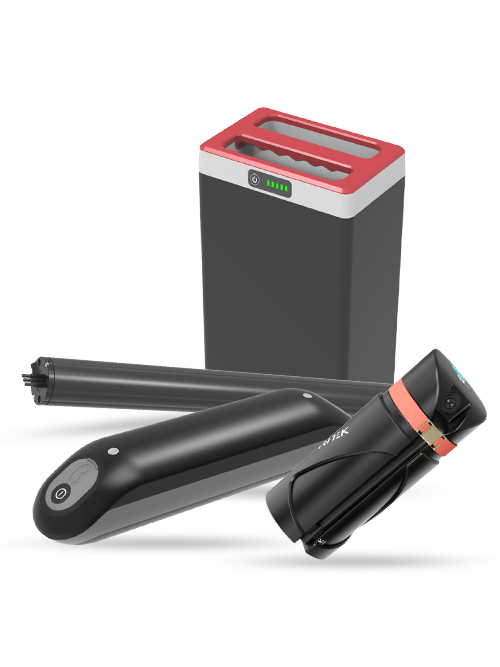
As robotic lawn mowers become increasingly popular in residential, commercial, and municipal landscaping, battery performance has become a key factor in overall machine efficiency. The robotic lawn mower battery determines runtime, charging frequency, cutting coverage, maintenance requirements, and product lifespan. Whether you are an OEM developing a new robotic mower, a brand sourcing battery packs, or a buyer evaluating battery options, selecting the right battery is critical to long-term success.
To choose a robotic lawn mower battery, evaluate battery chemistry, energy capacity (Wh), runtime requirements, cycle life, charging speed, safety features, waterproof protection, and battery management system (BMS) capabilities. Lithium-ion batteries are the preferred choice for most robotic lawn mowers because they provide higher energy density, longer lifespan, faster charging, and lower maintenance than traditional battery technologies.
However, not all lithium batteries are created equal. The right battery depends on lawn size, operating conditions, product positioning, and expected service life. This guide explains everything buyers and manufacturers need to know before selecting a robotic lawn mower battery.
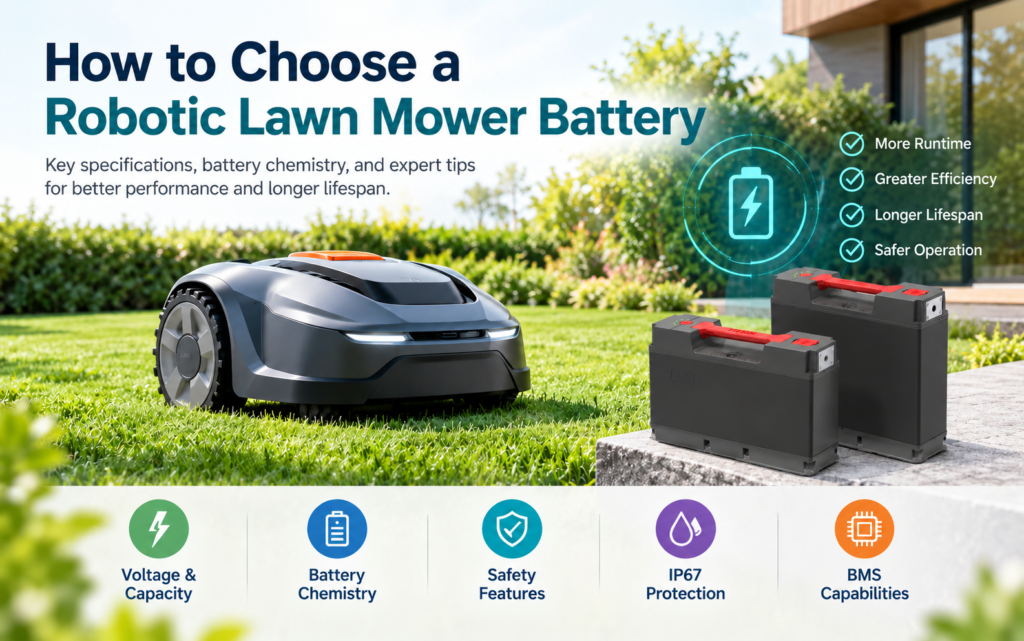
Why Is the Battery So Important in a Robotic Lawn Mower?
Unlike traditional lawn mowers that are manually operated, robot lawn mowers work autonomously and rely entirely on battery power.
The battery directly affects:
- Mowing area per charge
- Runtime
- Charging frequency
- Machine weight
- Climbing performance
- Reliability
- Maintenance costs
- Product lifespan
A poorly designed battery can lead to shorter runtime, excessive charging cycles, overheating issues, and premature replacement.
For manufacturers, battery selection also impacts product competitiveness, warranty costs, and customer satisfaction.
What Battery Specifications Matter Most?
Before comparing battery options, it is important to understand the key specifications.
Battery Voltage (V)
Voltage determines the power available to the mower’s drive motors and cutting system.
Common robotic lawn mower voltages include:
Voltage | Typical Application |
|---|---|
18V | Small residential lawns |
Medium-sized lawns | |
Large residential lawns | |
Commercial robotic mowers |
Higher voltage systems typically offer:
- Better efficiency
- Lower operating current
- Reduced heat generation
- Improved performance on slopes
Battery Capacity (Ah)
Ampere-hours (Ah) indicate how much electrical charge the battery can store.
Common capacities include:
- 2Ah
- 4Ah
- 5Ah
- 8Ah
- 10Ah
A higher Ah rating generally provides longer runtime.
However, capacity should never be compared based on Ah alone.
Battery Energy (Wh)
Watt-hours (Wh) represent the actual energy stored in the battery.
Formula:
Battery Energy (Wh) = Voltage × Capacity (Ah)
Examples:
Battery Pack | Energy |
|---|---|
18V 5Ah | 90Wh |
24V 5Ah | 120Wh |
36V 5Ah | 180Wh |
When comparing robotic lawn mower batteries, Wh is usually the most meaningful specification.
Which Battery Chemistry Is Best?
Lithium-Ion Batteries
Lithium-ion batteries have become the industry standard.
Advantages include:
- High energy density
- Lightweight design
- Longer runtime
- Fast charging
- Low self-discharge
- Maintenance-free operation
Typical cycle life: 500–2,000 cycles
For most robotic lawn mower applications, lithium-ion batteries provide the best balance between performance, weight, and cost.
Lithium Iron Phosphate (LiFePO4)
LiFePO4 batteries focus on safety and longevity.
Advantages include:
- Excellent thermal stability
- Longer cycle life
- Improved safety
- Better resistance to abuse
Typical cycle life: 2,000–5,000+ cycles
Potential drawbacks:
- Lower energy density
- Larger pack size
- Higher weight
LiFePO4 batteries are increasingly used in commercial robotic mowing equipment where durability is more important than compact size.
Lead-Acid Batteries
Lead-acid batteries were used in early robotic mower designs but are rarely used today.
Compared with lithium batteries, they are:
- Heavier
- Less efficient
- Slower to charge
- Shorter in lifespan
Modern robotic lawn mower manufacturers generally prefer lithium-based battery technologies.
How Much Battery Capacity Does a Robotic Lawn Mower Need?
The required battery capacity depends on:
- Lawn size
- Terrain
- Grass density
- Slope angle
- Cutting frequency
Small Residential Lawns
- Up to 500 m²
- Recommended battery capacity: 50–150Wh
- Typical runtime: 1–2 hours
Medium Residential Lawns
- 500–1500 m²
- Recommended battery capacity: 150–300Wh
- Typical runtime: 2–3 hours
Large Residential Lawns
- 1500–5000 m²
- Recommended battery capacity: 300–600Wh
- Typical runtime: 3–5 hours
Commercial Landscaping
- 5000+ m²
- Recommended battery capacity: 600Wh–2kWh+
- Typical runtime: 4–10+ hours
Commercial robotic mowers often require larger battery systems and fast charging capabilities to maximize productivity.
How Long Should a Robotic Lawn Mower Battery Last?
Battery lifespan is commonly measured in charge cycles.
One cycle equals a full discharge and recharge.
Typical battery life:
Battery Type | Cycle Life |
|---|---|
Lead-Acid | 300–500 |
Standard Lithium-Ion | 500–2,000 |
LiFePO4 | 2,000–5,000+ |
A robotic lawn mower may charge hundreds of times each year.
Therefore, cycle life has a major impact on long-term ownership costs.
A battery with a higher initial cost may ultimately provide lower total cost of ownership due to fewer replacements.
Why Charging Performance Matters
Many buyers focus exclusively on runtime.
However, charging time can be equally important.
For example:
Item | Runtime | Charging Time |
|---|---|---|
Battery 1 | 2 hours | 3 hours |
Battery 2 | 2 hours | 1 hour |
The second battery allows significantly more mowing time per day.
Look for batteries that support:
- Fast charging
- Intelligent charging algorithms
- Temperature-controlled charging
- High charging efficiency
These features improve productivity and reduce downtime.
What Safety Features Should a Robotic Lawn Mower Battery Have?
Because robot lawn mowers operate outdoors with minimal supervision, battery safety is critical.
Battery Management System (BMS)
A smart BMS should provide:
- Overcharge protection
- Over-discharge protection
- Overcurrent protection
- Short-circuit protection
- Overtemperature protection
The BMS continuously monitors battery health and helps prevent unsafe operating conditions.
Cell Balancing
Cell balancing ensures all battery cells maintain similar voltage levels.
Benefits include:
- Longer battery lifespan
- Better performance consistency
- Improved safety
Thermal Protection
Outdoor operation exposes batteries to varying temperatures.
Thermal management features help:
- Prevent overheating
- Improve battery lifespan
- Maintain performance consistency
Is Waterproof Protection Important?
Absolutely.
Robot lawn mowers routinely encounter:
- Rain
- Irrigation systems
- Wet grass
- Dust
- Mud
- Humidity
Battery packs should offer robust environmental protection.
Recommended ratings include:
IP65
Provides protection against dust and water spray.
Suitable for many residential applications.
IP67
Provides complete dust protection and temporary immersion resistance.
IP67-rated battery packs are often preferred for premium robotic lawn mowers and demanding outdoor environments.
Should You Choose a Removable Battery?
Battery design generally falls into two categories.
Integrated Battery
Advantages:
- Lower cost
- Compact design
- Better integration
Suitable for:
- Residential robotic mowers
Removable Battery
Advantages:
- Easy replacement
- Convenient charging
- Reduced downtime
- Simplified maintenance
Suitable for:
- Commercial robotic mowers
- Fleet operators
The best choice depends on the intended application and maintenance strategy.
What Smart Features Are Becoming Standard?
Modern robotic lawn mowers increasingly use intelligent battery technologies.
Popular features include:
Bluetooth Connectivity
Allows users to:
- Check battery status
- Monitor charging progress
- View diagnostics
Cloud Monitoring
Commercial systems may support:
- Fleet management
- Remote diagnostics
- Predictive maintenance
OTA Updates
Over-the-air updates enable manufacturers to improve:
- Charging algorithms
- Battery performance
- System reliability
Smart battery features are becoming important product differentiators.
Questions to Ask a Robotic Lawn Mower Battery Supplier
Before selecting a battery supplier, ask the following questions:
What Battery Cells Are Used?
Tier-1 cells generally provide better consistency and reliability.
What Certifications Does the Battery Have?
Common certifications include:
Can the Battery Be Customized?
Customization options may include:
- Voltage
- Capacity
- Housing design
- Communication protocols
- Waterproof rating
- Smart features
Does the Supplier Provide Engineering Support?
Strong technical support can significantly reduce development risk and accelerate product launch timelines.
Common Mistakes When Choosing a Robotic Lawn Mower Battery
Avoid these common mistakes:
❌ Comparing batteries only by Ah
❌ Choosing the lowest-cost option
❌ Ignoring cycle life
❌ Overlooking waterproof requirements
❌ Neglecting BMS functionality
❌ Selecting uncertified batteries
❌ Underestimating future capacity requirements
The lowest-priced battery is rarely the lowest-cost battery over its lifetime.
Conclusion
Choosing the right robotic lawn mower battery requires more than selecting the highest capacity available. Buyers should evaluate battery chemistry, energy capacity, runtime, charging performance, cycle life, safety systems, waterproof protection, and supplier capabilities.
For most robotic lawn mower applications, lithium-ion batteries offer the best balance of performance, weight, efficiency, and lifespan. Commercial applications may also benefit from LiFePO4 batteries when maximum durability and safety are priorities.
By selecting a high-quality battery pack with a robust BMS, appropriate certifications, and proven outdoor durability, manufacturers can improve product reliability, reduce warranty costs, and deliver a better user experience.
About Tritek
Tritek designs and manufactures intelligent customized lithium battery packs with advanced BMS technology, IP67 protection, communication capabilities, and OEM customization services. With more than 15 years of battery development experience, Tritek supports robotic lawn mower manufacturers with reliable battery solutions tailored to specific runtime, safety, and performance requirements.
Frequently Asked Questions
What type of battery is best for a robotic lawn mower?
Lithium-ion batteries are generally the best choice due to their high energy density, lightweight design, fast charging capability, and long lifespan.
How long does a robotic lawn mower battery last?
Most lithium-ion batteries last between 500 and 2,000 charge cycles, while LiFePO4 batteries can exceed 5,000 cycles with good care.
How much battery capacity does a robotic lawn mower need?
Small residential mowers may require only 50–150Wh, while commercial robotic mowers may require 600Wh to over 2kWh depending on coverage area and runtime requirements.
Is IP67 necessary for robotic lawn mower batteries?
IP67 protection is highly recommended for outdoor applications because it provides excellent resistance to dust, rain, and temporary water immersion.
Can I upgrade my robotic mower’s battery?
Yes, many models support higher-capacity compatible batteries for better performance.