The lowest operating temperature for a lithium-ion battery depends on its cell chemistry, cell model, and battery pack design. Many conventional lithium-ion batteries support discharging at temperatures as low as -20°C (-4°F), while specialized low-temperature batteries can operate at -30°C (-22°F) or below. However, their charging temperature limits are usually more restrictive.
For manufacturers and OEMs selecting lithium battery packs for cold-weather applications, understanding the difference between charging, discharging, and storage temperatures is essential. A battery that can supply power in freezing conditions may not be safe to recharge at the same temperature.
As winter approaches, these temperature limits become particularly important for e-bikes, electric motorcycles, robotics, agricultural equipment, and other applications that operate outdoors.
What Is the Operating Temperature Range of Lithium Batteries?
There is no single operating temperature range for all lithium batteries. The permitted range depends on the cell specifications and the complete battery system.
For many conventional lithium-ion cells, a general reference range is approximately:
Operating condition | Typical temperature range | Key consideration |
|---|---|---|
Discharging | -20°C to 60°C (-4°F to 140°F) | Available power and capacity may decrease in cold conditions |
Charging | 0°C to 45°C (32°F to 113°F) | Charging below 0°C is generally prohibited unless the cell is specifically designed and approved for it |
Storage | Varies by cell and state of charge | Follow the manufacturer’s recommended storage temperature and voltage |
These figures are general reference values, not universal limits or specifications for every lithium battery. Some cells have narrower operating ranges, while specialized designs support more extreme temperatures. Always verify the exact cell datasheet and battery manufacturer’s instructions.
For OEMs, the key question is not simply how cold a battery can operate. It is whether the battery can deliver the required voltage, current, runtime, and service life at the actual operating temperature.
How Does Cold Weather Affect Lithium Battery Performance?
Lithium batteries can continue working in cold weather, but their performance typically deteriorates as temperature decreases. Three effects are particularly important for battery-powered equipment.
Reduced available capacity
Low temperatures slow the electrochemical reactions inside a lithium-ion cell. As a result, the battery may deliver less usable capacity than it does at room temperature.
For example, an electric vehicle or e-bike battery may provide less operating range during winter, even when fully charged. The amount of capacity loss depends on the cell model, discharge rate, temperature, and battery management strategy.
OEMs should therefore evaluate battery capacity at the expected minimum operating temperature rather than relying exclusively on room-temperature capacity ratings.
Increased internal resistance
As temperature falls, a lithium-ion cell’s internal resistance generally increases. This can cause greater voltage drop under load and reduce the power available to the connected equipment.
The effect is especially relevant for applications requiring high discharge current, such as electric motorcycles accelerating in cold weather or robots operating motors under heavy loads.
If the battery voltage falls below the equipment’s operating threshold, the system may reduce power or shut down even though energy remains in the battery.
Slower charging and potential safety risks
Charging is more sensitive to low temperatures than discharging. When a conventional lithium-ion cell is charged below its permitted temperature range, lithium plating may occur on the anode.
This can cause permanent capacity loss and create additional safety risks. For this reason, many conventional lithium-ion cells prohibit charging below 0°C.
Specialized cells may permit low-temperature charging under specified conditions, but their limits must be verified rather than assumed.
The practical lesson is clear: low-temperature discharge capability does not automatically mean low-temperature charging capability.
Can Lithium Batteries Work Below 0°C?
Yes. Many lithium-ion batteries can discharge below freezing, provided the cell and battery pack are designed for the intended conditions.
However, three factors determine whether a battery can perform reliably in sub-zero environments.
Cell chemistry and model: Different lithium-ion chemistries and cell designs have different low-temperature characteristics. Even cells with the same nominal chemistry can behave differently because of electrode materials, electrolyte formulations, and internal construction.
Discharge requirements: A battery supplying a small, steady load may perform differently from one delivering high current to a motor. The required current and operating duration should be included in low-temperature testing.
Battery protection and system integration: The BMS, temperature sensors, discharge limits, and host equipment must work together. A pack may need to restrict current or disconnect the load when its temperature or voltage reaches a defined limit.
For example, an outdoor robot operating at -10°C may require a different battery configuration from an e-bike used occasionally in mild winter conditions. The appropriate solution depends on the application’s actual temperature profile, peak power demand, and runtime requirements.
Can You Charge Lithium Batteries in Freezing Temperatures?
For most conventional lithium-ion batteries, charging below 0°C is not permitted unless the specific cell is designed and approved for low-temperature charging.
At low temperatures, lithium ions move more slowly through the cell, and the graphite anode may not accommodate incoming lithium ions quickly enough during charging. This can cause metallic lithium to deposit on the anode.
Repeated exposure to unsuitable charging conditions can permanently degrade the cell and potentially compromise safety.
For battery-powered equipment used in winter, OEMs should consider the following measures:
- Charge within the specified temperature range. Do not assume that a battery capable of discharging at -20°C can also be charged at -20°C.
- Use BMS temperature protection. Temperature monitoring can prevent charging when the cells are outside their permitted range.
- Consider battery heating where necessary. A heating system can bring the cells into an acceptable charging temperature range before charging begins.
- Evaluate low-temperature charging requirements early. If the equipment must recharge outdoors in freezing conditions, select suitable cells and design the charging system around their verified specifications.
A compatible charger alone cannot make an unsuitable lithium-ion cell safe to charge below its specified temperature limit. The cell, BMS, charger, and thermal-management strategy must be engineered as a complete system.
Which Lithium Battery Is Best for Cold-Weather Applications?
Choosing a lithium battery for winter operation requires more than comparing nominal voltage and capacity. OEMs should assess the following factors.
Cell-level low-temperature performance
Request the manufacturer’s specifications for minimum discharge temperature, minimum charging temperature, and available capacity at low temperatures.
Where high current is required, examine discharge curves and voltage behavior at the expected operating temperature and load.
Battery management system (BMS)
The BMS should provide appropriate temperature monitoring and protection for the intended application.
Depending on system requirements, this may include:
- Charging and discharging temperature limits.
- Overcurrent and undervoltage protection.
- Defined recovery conditions after a temperature-related shutdown.
- Communication with the host controller or charger, where required.
For OEM applications, these settings should be coordinated with the equipment’s operating requirements and the cell manufacturer’s limits.
Thermal management
Battery enclosure design can affect how quickly cells cool down and how their temperature changes during operation.
Depending on the application, possible approaches include thermal insulation, enclosure optimization, or an integrated heating system. The correct approach depends on available space, energy consumption, environmental exposure, and operating duration.
Heating may improve cold-weather usability, but it also consumes energy and adds design complexity. It should be evaluated against the application’s actual requirements.
Validation under real operating conditions
A battery’s minimum specified operating temperature does not guarantee that it will meet every performance target at that temperature.
OEMs should validate the complete battery system under representative conditions, including:
- Cold-soak testing before startup.
- Discharge at the required continuous and peak currents.
- Usable capacity and voltage under load.
- Charging behavior after cold exposure.
- Temperature protection and recovery behavior.
- Repeated winter operating cycles.
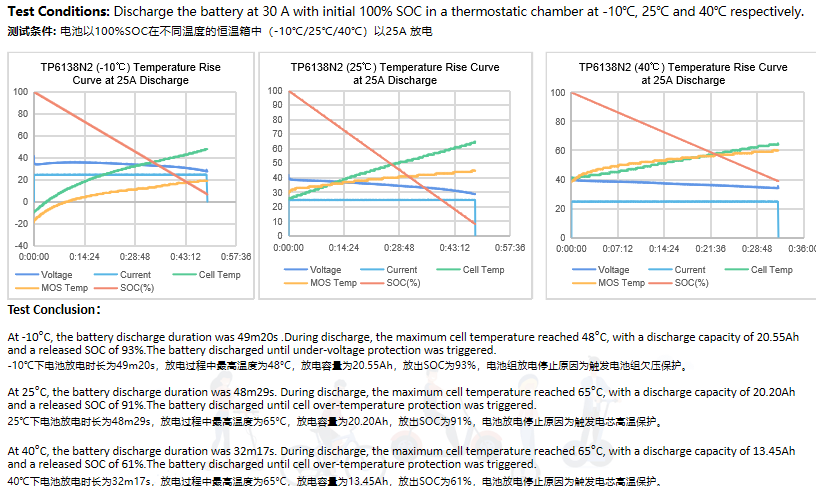
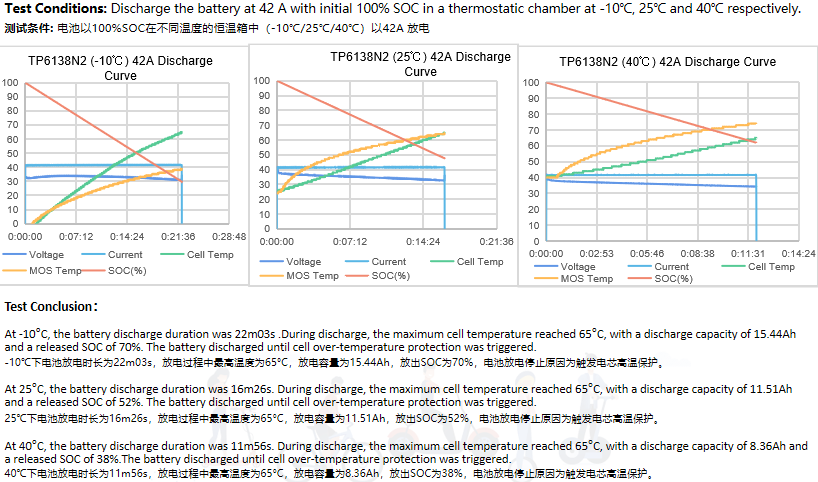
These tests help determine whether the battery meets the application’s power, runtime, safety, and service-life requirements.
Custom Lithium Battery Solutions for Cold-Weather Applications
Selecting the right battery for winter operation requires a balance of low-temperature performance, power output, usable capacity, safety, and system integration.
Tritek develops customized lithium battery packs for light electric vehicles, robotics, AGVs, and other specialized applications. Battery specifications can be evaluated against project requirements, including discharge current, operating temperature, BMS protection, communication interfaces, enclosure constraints, and charger compatibility.
For OEMs and system integrators, the goal is to identify a battery configuration that meets the actual operating conditions, not simply choose a battery based on its nominal capacity.
If your product needs to operate in freezing or sub-zero environments, share your target temperature range, voltage, capacity, discharge current, and charging requirements with Tritek’s engineering team to discuss a suitable battery solution.
Contact Tritek to discuss your custom lithium battery pack requirements.
Frequently Asked Questions
What is the lowest temperature a lithium battery can withstand?
Many conventional lithium-ion batteries support discharging down to approximately -20°C, while specialized cells can operate at -30°C or lower. The exact limit depends on the cell model, chemistry, and battery design.
Do lithium batteries stop working in cold weather?
Not necessarily. Lithium batteries can continue operating below freezing, but available capacity and power may decrease. Under heavy loads, voltage drop may cause equipment to reduce power or shut down.
Can lithium batteries be charged at -10°C?
Most conventional lithium-ion cells do not permit charging at -10°C. Charging is only appropriate if the specific cell is designed and approved for that temperature, with the required charging controls and operating limits.
Does cold weather permanently damage lithium batteries?
Cold weather alone does not necessarily cause permanent damage. However, charging outside the cell’s permitted low-temperature range can cause lithium plating and irreversible degradation. Repeated operation outside specified limits can also reduce battery life.
Read more: