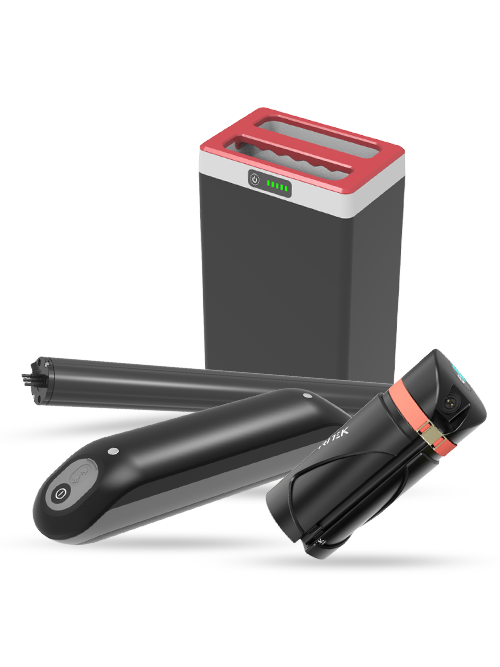
EU Regulation 2023/1542, known as the EU Battery Regulation, establishes comprehensive rules for batteries throughout their lifecycle. Published in 2023, it replaces the 2006 Battery Directive with stricter requirements on sustainability, carbon footprint, performance, and digital traceability, applying to all batteries placed on the EU market, including e-bike and LMT batteries. It aligns with the European Green Deal by addressing waste, resource scarcity, and supply chain risks.
Introduction
The EU Battery Regulation (EU) 2023/15421 marks a pivotal shift in how batteries are designed, produced, used, and recycled across the European Union. Effective from August 2023, it aims to reduce environmental impact from the booming demand for batteries in electric vehicles (EVs), energy storage, and consumer electronics. Unlike the previous directive, this regulation is directly applicable in all EU member states without needing national transposition, ensuring uniform enforcement.
Batteries power the green transition but pose challenges like hazardous waste and reliance on critical raw materials such as lithium and cobalt. The regulation tackles these by mandating sustainability, transparency, and recycling efficiency.
Background and Policy Purpose
The regulation stems from the EU’s European Green Deal2 and Circular Economy Action Plan3, targeting a climate-neutral Europe by 2050. It responds to surging battery waste (projected to reach millions of tons annually) and geopolitical vulnerabilities in raw material supply chains.
Key drivers include:
- Promoting battery durability, repairability, and recyclability.
- Reducing reliance on virgin materials through recycled content quotas.
- Enhancing supply chain due diligence to prevent human rights abuses in mining.
By 2030, the EU expects batteries to underpin 30 million EVs, amplifying the need for responsible management.
Scope of Application
The regulation applies to all battery categories, including:
- Portable batteries (consumer electronics)
- Light means of transport (LMT) batteries (e-bikes, e-scooters, electric motorcycles)
- Electric vehicle batteries
- Industrial batteries (ESS, backup power systems)
Key Requirements of EU 2023/15424
1. Carbon Footprint Declaration
Manufacturers must calculate and declare the lifecycle carbon footprint of batteries.
- Applies initially to:
- EV batteries
- Industrial batteries
- EV batteries
- Industrial batteries
- Includes:
- Raw material extraction
- Manufacturing
- Transportation
- Raw material extraction
- Manufacturing
- Transportation
Future phases will introduce maximum carbon thresholds, meaning high-emission batteries may be restricted.
2. Digital Battery Passport (Digital Product Passport)
One of the most transformative requirements.
What It Includes
Each battery must have a digital identity (via QR code) containing:
- Manufacturer and model data
- Battery chemistry and capacity
- Performance metrics
- Carbon footprint data
- Recycling and end-of-life information
Why It Matters
- Enables full lifecycle traceability
- Simplifies compliance checks
- Supports second-life and recycling markets
For suppliers, this requires robust data infrastructure, not just hardware capability.
3. Performance and Durability Requirements
For LMT batteries (e-bikes, scooters), the regulation introduces:
- Minimum cycle life thresholds
- Capacity retention requirements over time
This directly impacts:
- Cell selection
- BMS design
- Thermal management
Low-quality batteries that degrade quickly will no longer be compliant.
4. Safety and Compliance Alignment
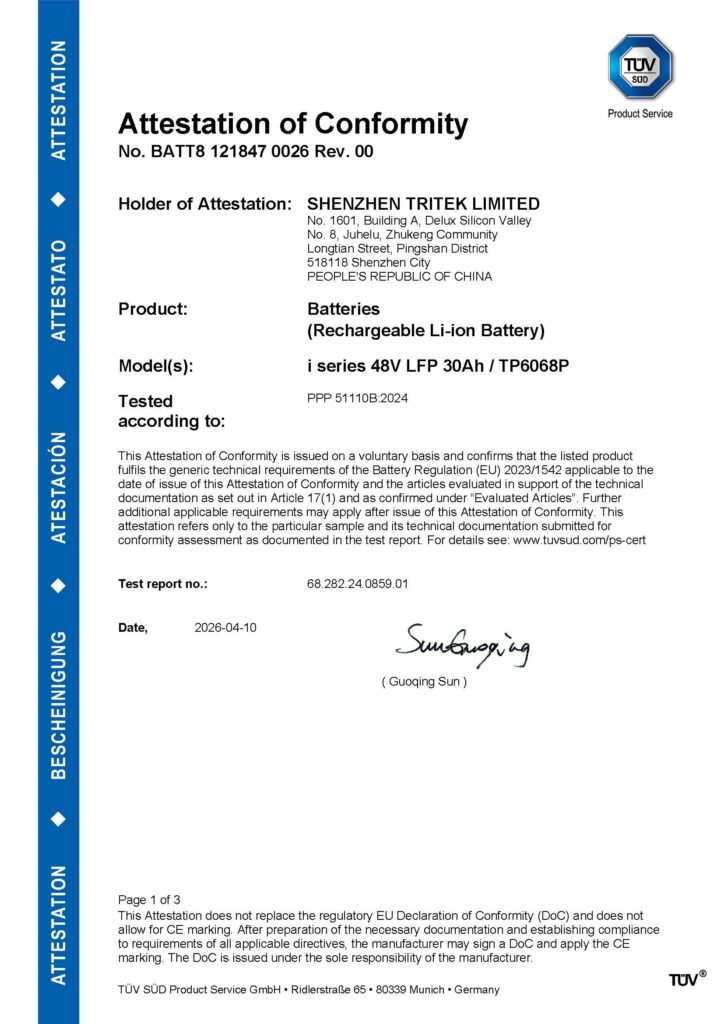
EU 2023/1542 builds on existing safety frameworks:
- CE marking requirements
- UN38.3 transport certification
But adds:
- Stricter technical documentation
- Enhanced conformity assessment procedures
5. Recycled Content Requirements
The regulation mandates minimum levels of recycled materials:
- By 2031: 16% cobalt, 6% lithium, 6% nickel from recycled sources.
- By 2036: Rising to 26% cobalt, 12% lithium, 15% nickel.
These targets will increase over time, pushing manufacturers toward closed-loop supply chains.
6. Collection and Recycling Obligations
Producers must:
- Meet battery collection targets
- Participate in extended producer responsibility (EPR) schemes
- Ensure minimum recycling efficiency rates
Extended Producer Responsibility (EPR) requires collection rates:
- 63% by 2027, 73% by 2030 for portable batteries.
- 51% for light transport batteries by 2028.
Recycling efficiency targets include 65% cobalt recovery by 2028. Reuse and second-life applications (e.g., stationary storage) are prioritized before recycling.
7. Supply Chain Due Diligence Obligations
Companies must implement policies to address:
- Environmental risks
- Human rights issues
- Ethical sourcing of raw materials
This is especially critical for sourcing from regions with high ESG risk.
Compliance Timeline
Key dates:
- 18 August 2023: Entry into force.
- 18 August 2025: General sustainability and labeling rules.
- February 2027: Battery passport for industrial batteries; performance labeling.
- 2027-2031: Phased recycled content and collection targets.
- Ongoing: Annual reporting via EU databases.
Why Was EU 2023/1542 Introduced?
The previous directive was no longer sufficient for a rapidly evolving battery industry.
Key Gaps in the Old Framework
- Limited lifecycle coverage
- Weak sustainability enforcement
- Lack of carbon footprint accountability
- Inconsistent enforcement across EU countries
Core Objectives of the New Regulation
- Enable a circular battery economy
- Reduce environmental impact
- Improve resource efficiency (lithium, cobalt, nickel)
- Strengthen supply chain transparency
- Standardize compliance across the EU
In short, the regulation shifts the industry from “safe batteries” → “sustainable and traceable batteries.”
EU 2023/1542 vs Battery Directive 2006/66/EC
Aspect | Old Directive | EU 2023/1542 |
|---|---|---|
Legal nature | Directive | Regulation |
Enforcement | Country-level | EU-wide uniform |
Lifecycle coverage | Limited | Full lifecycle |
Carbon footprint | Not required | Mandatory |
Battery passport | No | Yes |
Sustainability | Basic | Advanced |
FAQ (SEO Section)
Is EU 2023/1542 mandatory?
Yes. It is a legally binding regulation for all batteries placed on the EU market.
Does it apply to e-bike batteries?
Yes. LMT batteries, including e-bikes and scooters, are a key focus area.
What is a battery passport?
A digital record containing technical, environmental, and lifecycle data of a battery, accessible via QR code.
When does EU 2023/1542 take effect?
It entered into force in 2023, with phased requirements starting from 2024 onward.
What happens if a battery is not compliant?
It may be denied entry into the EU market, recalled, or subject to penalties.
- Regulation (EU) 2023/1542 on EUR-Lex, for the legal text and binding requirements: https://eur-lex.europa.eu/eli/reg/2023/1542/oj ↩︎
- European Commission’s European Green Deal page, for the climate-policy link: https://commission.europa.eu/strategy-and-policy/priorities-2019-2024/european-green-deal_en ↩︎
- European Commission’s Circular Economy Action Plan page, for the circular-economy background: https://environment.ec.europa.eu/topics/circular-economy-topics/first-circular-economy-action-plan_en ↩︎
- Key Requirements of EU 2023/1542: https://unece.org/sites/default/files/2024-10/4_EU_Rev.1.pdf ↩︎
Read more: