When evaluating lithium batteries, specifications such as battery voltage, capacity (Ah), and energy (Wh) often receive the most attention. However, in real-world applications, discharge current is the parameter that directly determines whether a battery can safely and reliably power a system.
Continuous discharge current refers to the maximum current a lithium battery can deliver steadily over time without overheating or degradation, while peak discharge current is the short-term current the battery can supply for brief events such as acceleration or motor startup. Confusing these two values may result in reduced performance, shortened battery life, or safety risks.
Although both parameters describe how much current a battery can output, continuous and peak discharge current are defined, tested, and applied in very different ways. To select the right battery for a specific application, it is crucial to understand what each rating truly represents and how they interact with load behavior, thermal limits, and BMS protection logic.
What Is Discharge Current in Lithium Batteries?
Discharge current is the amount of electrical current a battery delivers to an external load during operation. It directly affects:
- Output power (Power = Voltage × Current)
- Heat generation inside the cells
- Voltage stability under load
- Long-term battery lifespan
In lithium battery systems, discharge current is not determined by the cells alone. It is jointly limited by cell chemistry, pack design, BMS configuration, and thermal conditions. For this reason, manufacturers specify both continuous and peak discharge current ratings to define safe operating boundaries.
What Is Continuous Discharge Current?
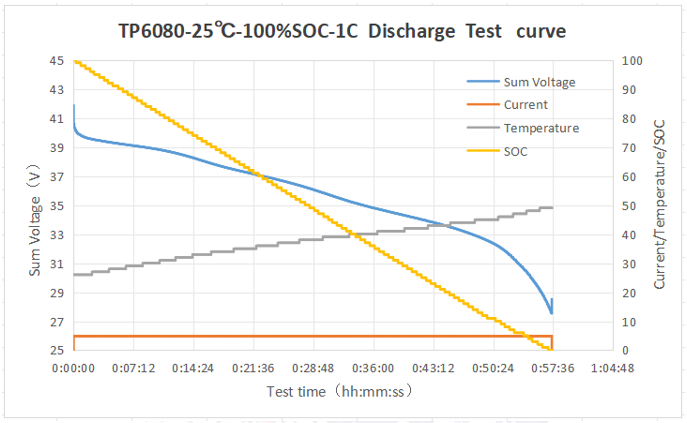
The continuous discharge current (also called Maximum Continuous Discharge Current or CDR) is the highest current a lithium battery can deliver steadily without excessive heat buildup, significant voltage drop, or long-term damage. It’s designed for sustained loads lasting minutes to hours.
This rating is often expressed in amperes (A) or as a C-rate, which represents the discharge rate relative to the battery’s capacity. The C-rate multiplies the battery’s capacity: for a 100Ah battery at 1C, the continuous discharge is 100A.
Factors like internal resistance, cell chemistry (e.g., Li-ion, LiFePO4, or LiPo), and heat dissipation limit this value. As discharge current rises, internal resistance increases, leading to higher heat generation and voltage drop. High-quality cells balance energy density with safe sustained output.
Why Max Continuous Discharge Current Matters Most
Continuous discharge current determines:
- The sustainable power output of the system
- Whether the battery can handle long-duration loads
- Thermal stability during normal operation
For most applications, this is the most critical parameter when selecting a battery.
Application Examples
- E-bikes: Continuous current supports cruising, hill climbing, and steady riding speed. If undersized, the battery may overheat or trigger BMS protection on long climbs.
- AGVs / AMRs: Continuous current defines whether the vehicle can operate for hours under constant load without derating or shutdown.
- Logistics equipment: Conveyor systems, tow tractors, and automated carts rely on stable continuous current to maintain uptime in 24/7 operations.
What is Peak (Pulse) Discharge Current?
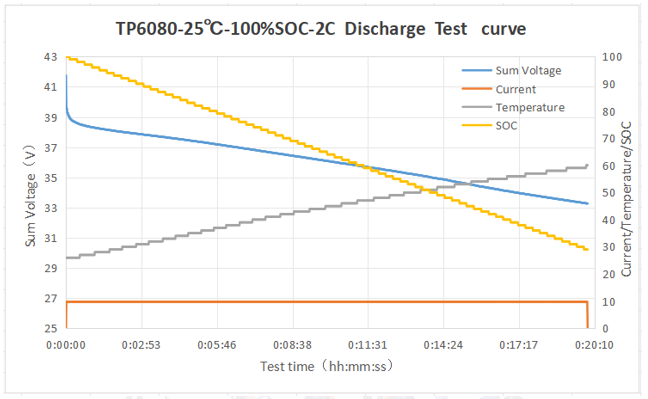
The peak discharge current (or pulse/max burst current) is the significantly higher amperage a battery can handle for very short durations, typically 10–30 seconds, sometimes less.
This rating often reaches 2–10 times the continuous value (e.g., 20A continuous vs. 100A peak). It supports power spikes like drone takeoff, power tool startup torque, or EV acceleration.
Exceeding the duration or repeating bursts too frequently causes rapid heating, voltage sag, and accelerated degradation. Peak ratings are not for sustained use.
Continuous vs Peak Discharge Current: Key Differences
Aspect | Continuous Discharge Current | Peak/Pulse Discharge Current |
|---|---|---|
Duration | Long-term (minutes to hours) | Short bursts (seconds) |
Typical Rating | Lower (e.g., 1C–5C or 10–30A) | Higher (e.g., 10C–50C or 50–200A) |
Heat Generation | Moderate and manageable | High and rapid |
Impact on Battery Life | Minimal if within limits | Reduces cycle life if frequently exceeded |
Voltage Behavior | Stable with minor sag | Significant temporary drop (voltage sag) |
Real-World Example | Steady cruising in an EV or running a fridge | Acceleration in an e-bike or tool startup |
Both relate to C-rate: Discharge Current (A) = C-rate × Capacity (Ah). Higher rates deliver power faster but reduce total usable capacity due to internal losses.
Exceeding either limit risks overheating, capacity fade, or, in extreme cases, venting or fire.
How the BMS Controls Discharge Current
A lithium battery’s Battery Management System (BMS) plays a central role in current control. It continuously monitors:
- Output current
- Cell and pack temperature
- Voltage balance
The BMS enforces:
- A continuous current limit for normal operation
- A peak current threshold with time-based control
In well-designed systems, the BMS ensures that peak current is available when needed, while preventing thermal or electrical abuse. This system-level coordination is especially important in high-load applications such as e-mobility and industrial automation, where intelligent BMS design significantly improves reliability.
Conclusion
Continuous and peak discharge current are not competing specifications, but complementary design limits. One defines long-term operating stability, while the other supports brief, high-demand events. Evaluating them in isolation often leads to incorrect assumptions about battery capability. A clear understanding of how both values interact with load behavior and BMS control is essential for building reliable lithium battery systems in real-world applications.
Looking to match continuous and peak discharge current precisely to your application? Tritek supports lithium battery system design with application-specific BMS tuning and discharge current optimization for e-mobility and industrial equipment. Contact us now!