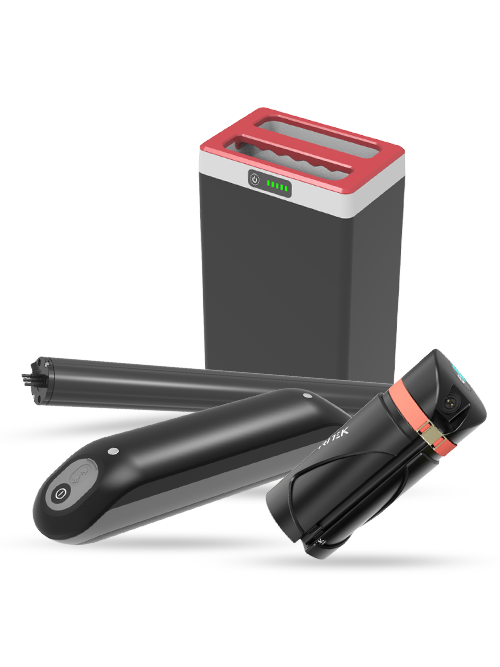
Lithium-ion batteries are now the backbone of industrial energy systems, powering everything from AGVs and forklifts to energy storage systems (ESS), robotics, and telecom backup systems. As deployment scales, safety expectations have become stricter, especially for high-energy industrial applications. Among global safety frameworks, IEC 62619 has emerged as one of the most important international standards for industrial lithium batteries.
IEC 62619 is an international safety standard that specifies requirements and tests for lithium-ion batteries used in industrial applications. It ensures batteries are designed and tested to prevent fire, explosion, and hazardous failure under normal operation and abnormal conditions such as overcharge, short circuit, vibration, and thermal abuse.
Unlike consumer-focused standards, IEC 62619 is designed specifically for high-energy, high-risk industrial use cases, where battery failure can lead to operational downtime, equipment damage, or serious safety incidents.
This guide breaks down IEC 62619 from a technical and procurement perspective, including requirements, test items, certification process, and how it compares with other global standards.
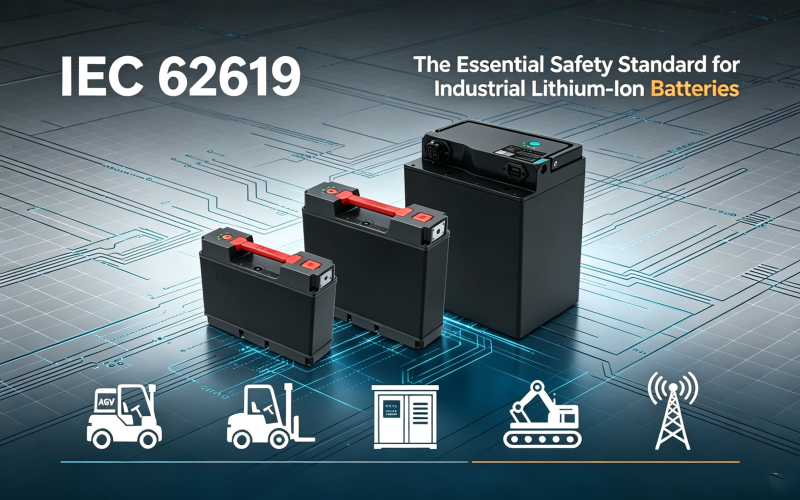
What Is IEC 62619?
IEC 62619 is an International Electrotechnical Commission (IEC) standard titled:
Secondary cells and batteries containing alkaline or other non-acid electrolytes – Safety requirements for secondary lithium cells and batteries, for use in industrial applications.
It specifies safety requirements and type tests for lithium-based rechargeable batteries used in industrial contexts. The latest edition, IEC 62619:2022, updates and replaces the 2017 version, reflecting advancements in battery technology and lessons from real-world deployments.
The standard focuses on preventing hazards such as thermal runaway, fire, explosion, leakage, and electrical faults under normal use, foreseeable misuse, and specific abuse conditions.
Scope of IEC 62619: What It Covers (and What It Doesn’t)
IEC 62619 applies to:
- Stationary applications: Telecom base stations, uninterruptible power supplies (UPS), electrical energy storage systems (ESS), utility switching, emergency power, and grid-scale storage.
- Motive applications: Forklifts, golf carts, automated guided vehicles (AGVs), railway vehicles, marine vessels (excluding road vehicles).
It covers both individual cells and complete battery systems (packs/modules with management systems).
Exclusions:
- Consumer/portable electronics (covered by IEC 62133).
- Road vehicles/EVs (covered by the IEC 62660 series).
- Primary (non-rechargeable) batteries.
The standard applies across lithium chemistries (LFP, NMC, NCA, etc.) as long as the electrolyte is non-aqueous.
Core Requirements and Key Tests in IEC 62619:2022
The standard evaluates safety across electrical, mechanical, environmental, and functional dimensions. Testing occurs at cell and battery levels.
Electrical Tests
- External short circuit
- Overcharge protection
- Over-discharge protection
- Over-temperature protection
- Voltage and current control
Mechanical and Environmental Tests
- Drop test
- Impact/crush
- Vibration
- Thermal cycling
- Shock
- Altitude simulation (related to transport safety)
Functional Safety (Battery Level)
- Evaluation of the Battery Management System (BMS) for critical protections.
- Tests for abnormal operation and fault conditions.
Tests are conducted under controlled conditions (e.g., 25±5°C) with specific pass/fail criteria, including no fire, explosion, leakage, or venting in most cases.
The 2022 edition includes refinements based on industry feedback, improved clarity on test procedures, and better alignment with related standards.
IEC 62619 vs. Other Battery Safety Standards
Standard | Focus | Applications | Level | Key Difference from IEC 62619 |
|---|---|---|---|---|
IEC 62619 | Industrial lithium safety | Stationary + motive (non-road) | Cells & Packs | Comprehensive industrial focus |
Portable/consumer | Electronics, small devices | Cells & Packs | Smaller consumer applications | |
IEC 62660 | Road vehicles/EVs | Automotive | Varies | Vehicle-specific performance |
Transport safety | All lithium batteries | Cells & Packs | Shipping-focused (mandatory) | |
UL 1642 | Lithium cells (US-centric) | Various | Cells | Cell-level only |
UL 1973 | Stationary storage | ESS (US) | Packs/Systems | Often complements IEC |
Many manufacturers pursue IEC 62619 + UN 38.3 as a baseline for global market entry, with UL or additional certifications for specific regions.
Frequently Asked Questions (FAQ)
Is IEC 62619 mandatory?
Not universally, but it is widely required by industrial OEMs and procurement specifications.
What batteries require IEC 62619?
Industrial lithium-ion batteries used in ESS, robotics, forklifts, and telecom systems.
Does IEC 62619 apply to LiFePO₄ batteries?
Yes. Chemistry is allowed as long as safety requirements are met.
How long does IEC 62619 certification take?
Typically 6–12 weeks depending on design maturity.
Is IEC 62619 accepted globally?
Yes, it is widely recognized in Europe, Asia, and industrial procurement systems worldwide.
What is the difference between IEC 62619 and UN38.3?
UN38.3 is for transportation safety; IEC 62619 is for operational safety.
Can a battery have both IEC 62619 and UL certifications?
Yes, many industrial batteries are dual-certified for global markets.