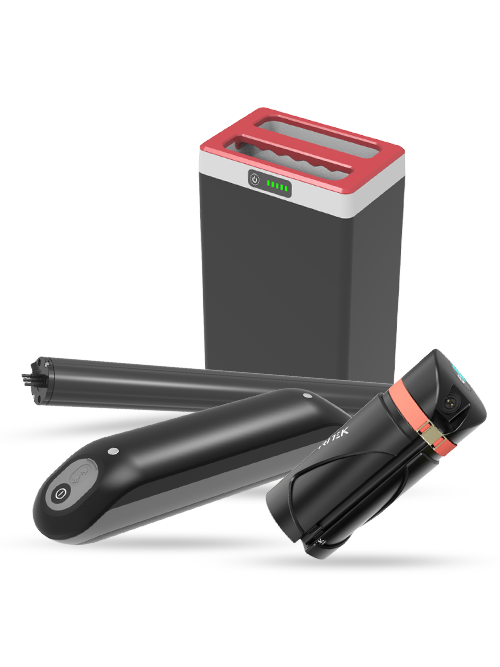
Battery communication protocols are the backbone of modern intelligent battery systems. They allow the Battery Management System (BMS) to exchange critical data with vehicles, chargers, controllers, energy storage systems, cloud platforms, and mobile applications. Whether you are designing an e-bike battery, industrial lithium battery, or energy storage system, selecting the right communication protocol is essential for safety, performance, diagnostics, and future scalability.
The most common battery communication protocols are CAN Bus, RS485, UART, Modbus, SMBus, Bluetooth, and TCP/IP. CAN Bus is the dominant standard for electric vehicles and e-bikes, while RS485 is widely used in industrial and energy storage applications. The best protocol depends on communication distance, data complexity, system architecture, and integration requirements.
As battery systems become smarter and more connected, communication is no longer an optional feature. It is a fundamental requirement for real-time monitoring, predictive maintenance, remote diagnostics, fleet management, and over-the-air updates. Understanding the strengths and limitations of each protocol can help OEMs choose the most suitable solution for their application.
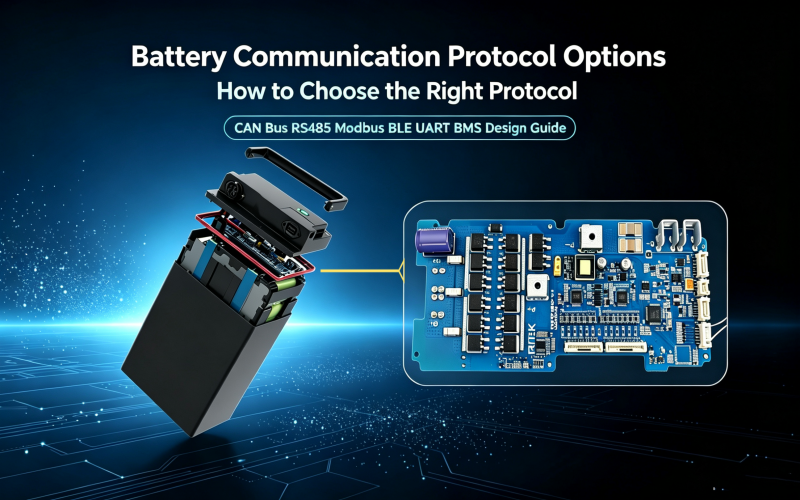
Why Battery Communication Protocols Matter
A battery pack is no longer just a collection of cells. Modern lithium batteries contain sophisticated electronics capable of monitoring and managing every aspect of battery operation.
Communication protocols provide the channel through which this information is shared with external devices.
What Data Does a Smart Battery Exchange?
A modern BMS can transmit a wide range of operational data, including:
- State of Charge (SOC)
- State of Health (SOH)
- Pack voltage
- Cell voltage
- Current
- Temperature
- Remaining capacity
- Charge and discharge status
- Fault and warning codes
- Cycle count
- Battery serial number
- GPS location
- Firmware version
- OTA update status
What Happens Without Communication?
Without a communication protocol, battery systems become significantly less intelligent and more difficult to manage.
Potential challenges include:
- Inability to monitor battery health
- Limited fault diagnosis capabilities
- Reduced safety visibility
- Compatibility issues with controllers and chargers
- Lack of fleet management functionality
- No remote monitoring or software updates
Common Battery Communication Protocol Options
Several communication protocols are widely used in battery systems today. Each protocol was developed for specific environments and offers unique advantages.
Controller Area Network (CAN Bus / CAN FD)
CAN Bus is the most widely adopted communication protocol in electric vehicles and intelligent battery systems.
Originally developed for automotive applications, CAN Bus is designed to provide reliable communication in electrically noisy environments while supporting multiple devices on the same network.
How CAN Bus Works
In a CAN network, devices communicate through shared communication lines known as CAN High and CAN Low.
Each device can transmit and receive messages, allowing batteries, controllers, chargers, displays, and telematics systems to exchange information in real time.
- Key Specs: Up to 1 Mbps (standard CAN); CAN FD supports higher data rates (up to 8-10 Mbps in data phase) and larger payloads (up to 64 bytes). Typical distance: ~40m at 1 Mbps (longer at lower speeds).
- Advantages of CAN Bus: Excellent noise immunity, hardware-level arbitration, real-time data transmission, multi-node support, strong fault detection mechanisms.
- Limitations of CAN Bus: Limited distance at high speeds, requires termination resistors, moderate complexity.
- Applications: EVs, hybrid vehicles, e-bikes, heavy machinery, and high-performance ESS.
RS-485 and Modbus (RTU/TCP)
RS485 is a robust serial communication protocol widely used in industrial automation and energy systems.
It is particularly valued for long-distance communication and excellent resistance to electrical interference.
How RS485 Works
RS485 uses differential signaling to transmit data between devices.
Multiple devices can communicate on the same bus, making it suitable for distributed industrial systems.
- Key Specs: Up to 10 Mbps (short distance); typical 100 kbps–115 kbps for longer runs. Distances up to 1,200m at lower speeds. Supports 32+ devices (more with repeaters).
- Advantages: Long range, robust in noisy environments, easy integration with PLCs and SCADA, cost-effective.
- Limitations: Master-slave architecture, limited built-in error handling, lower communication speed than CAN Bus.
- Applications: Stationary energy storage systems (ESS), solar inverters, grid-tied batteries, UPS, and remote monitoring.
UART (Universal Asynchronous Receiver-Transmitter) / RS-232
UART is one of the simplest communication methods available.
It provides direct point-to-point communication between two devices and is often used for battery configuration, debugging, and basic monitoring functions.
- Key Specs: Up to ~1 Mbps, short range (typically <10–15m).
- Advantages: Very low cost, easy implementation, minimal wiring (TX, RX, GND).
- Limitations: Short distance, susceptible to noise, limited multi-device support.
- Applications: Prototyping, small battery packs, e-bikes, internal module communication.
I2C / SMBus / PMBus
SMBus (System Management Bus) is derived from the I²C communication standard and is commonly used in compact electronic devices.
These protocols are designed for short-distance communication between components within a device.
- Key Specs: Up to 3.4 Mbps (high-speed mode), short range (~1m).
- Advantages: Low power, simple wiring, ideal for intra-pack sensor communication.
- Limitations: Noise-sensitive, limited distance and robustness.
- Applications: Consumer electronics, laptops, power tools, internal BMS modules.
SPI
SPI is a high-speed, full-duplex, master-slave protocol using four wires.
- Advantages: Very fast data rates (up to tens of MHz), suitable for high-bandwidth internal communication.
- Limitations: More wires, short range, dedicated CS lines per slave.
- Applications: High-speed sensor interfaces or chip-to-chip within BMS boards.
Wireless Options: BLE, Wi-Fi, Zigbee, and Emerging Technologies
- Bluetooth Low Energy (BLE): Low power, ranges 10–100m+.
- Advantages: Low power consumption, flexibility, reduced cabling, remote access.
- Limitations: Power use (relative to wired), security/latency concerns, interference, not suitable for mission-critical control systems.
- Applications: Consumer batteries, smart home storage, fleet monitoring.
Other Protocols
- LIN: Low-cost, low-speed for auxiliary systems.
- Ethernet-based: Growing for high-bandwidth needs.
- Proprietary: Manufacturer-specific (e.g., Pylontech CAN).
Side-by-Side Comparison of Battery Communication Protocols
Here is a detailed comparison table based on typical BMS implementations:
Protocol | Data Rate | Max Distance (Typical) | Topology | Noise Immunity | Power Consumption | Nodes Supported | Best Applications | Complexity / Cost |
|---|---|---|---|---|---|---|---|---|
CAN / CAN FD | 1 Mbps (CAN); up to 8-10 Mbps (FD) | ~40m at 1 Mbps (longer at lower speeds) | Multi-master bus | Excellent | Medium | ~30–110 | EVs, Automotive, Real-time control | Medium |
RS-485 / Modbus | Up to 10 Mbps (short); 100–115 kbps (long) | Up to 1,200m at lower speeds | Multi-drop (master-slave) | Very Good | Low-Medium | 32+ (with repeaters) | Stationary ESS, Industrial, Grid-tied | Low |
UART / RS-232 | Up to ~1 Mbps | Short (~10–15m) | Point-to-point | Poor | Very Low | 2 (or daisy-chain limited) | Prototyping, Small packs, Internal comms | Very Low |
I2C / SMBus | Up to 3.4 Mbps (high-speed) | ~1m | Multi-device bus | Medium | Very Low | Up to 100+ | Intra-pack sensors, Consumer electronics | Low |
SPI | Very High (tens of MHz) | Very short (<1m) | Master-slave (dedicated CS) | Medium | Low | Limited by pins | High-speed internal chip-to-chip | Low-Medium |
Wireless (BLE) | Varies (up to ~2 Mbps) | 10–100m+ | Star / Mesh | Variable (interference) | Low-Medium | Many | Remote monitoring, Portable / IoT | Medium-High |
Key Insights: CAN excels in real-time, noisy, multi-node environments. RS-485/Modbus dominates long-distance industrial setups. Internal/short-range protocols like I2C and SPI are preferred for cost and simplicity within battery packs.
Protocol Selection Guide for Different Applications
- Electric Vehicles and Automotive: Prioritize CAN / CAN FD for robustness and real-time performance. Automotive Ethernet is emerging.
- Energy Storage Systems (ESS) and Grid: Modbus over RS-485 for compatibility with inverters/PLCs. CAN for higher performance needs.
- Consumer Electronics and Portable: SMBus/I2C or BLE for low power and compactness.
- Industrial, Robotics, Marine, UAVs: RS-485/CAN for reliability over distance.
Selection Checklist:
- Define data volume, latency, and real-time requirements.
- Assess environment (noise, distance, temperature extremes).
- Consider interoperability with existing equipment (e.g., inverters).
- Factor in security, scalability, certifications, and future-proofing.
- Evaluate total cost, including hardware and development.
Multi-protocol gateways or BMS with dual support (e.g., CAN + RS-485) solve interoperability challenges.
Conclusion: Choosing the Right Battery Communication Strategy
Battery communication protocols are no longer just technical implementation details, they define how intelligent, connected, and scalable a battery system can be.
The right choice depends on:
- Application type (mobility, industrial, energy storage)
- Communication distance
- Data complexity
- Real-time control requirements
- Cloud connectivity needs
In most modern systems, a hybrid communication approach is becoming the standard rather than a single-protocol design.
For OEMs developing next-generation battery systems, selecting the right communication architecture early in the design phase is critical for performance, safety, and long-term scalability.
About Intelligent Battery Solutions
Tritek Battery provides customized intelligent battery systems with flexible communication architectures, including CAN Bus, RS485, UART, Bluetooth, and 4G solutions. With advanced BMS integration and full-stack customization capability, Tritek supports OEMs in building scalable and future-ready battery products for e-mobility and energy storage applications.
FAQs
What is the most common communication protocol for BMS in EVs?
CAN Bus (and increasingly CAN FD).
CAN Bus vs Modbus/RS-485: Which is better for energy storage?
Modbus/RS-485 for long-distance and industrial compatibility; CAN for superior real-time and noise performance.
Are wireless protocols suitable for critical battery systems?
Better for supplementary monitoring; wired protocols preferred for primary control.
How do I ensure protocol interoperability?
Use multi-protocol BMS, gateways, or verify manufacturer compatibility lists.
What future protocols should I watch?
Automotive Ethernet, enhanced CAN variants, and advanced IoT protocols.