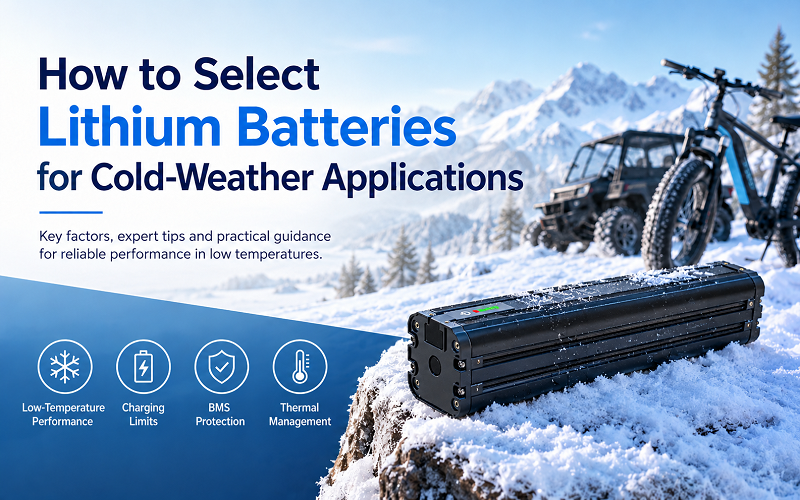
Selecting lithium batteries for cold-weather applications requires more than checking the minimum operating temperature on a datasheet. OEMs must evaluate low-temperature discharge performance, charging restrictions, usable capacity, BMS protection, and thermal management to ensure the battery meets the equipment’s actual operating requirements.
The most effective approach is to define the application’s temperature and power requirements first, compare battery cells against those requirements, and validate the complete battery pack under realistic cold-weather conditions.
1. Define the Required Operating Temperature
Before comparing lithium battery suppliers, establish the temperature conditions the battery must withstand.
The minimum ambient temperature alone is not enough. The battery’s internal cell temperature can differ from the surrounding air temperature depending on enclosure design, insulation, operating load, and exposure time.
OEMs should define three separate temperature requirements:
Temperature parameter | What to evaluate |
|---|---|
Minimum discharge temperature | The lowest cell temperature at which the battery must deliver power |
Minimum charging temperature | The lowest temperature at which the battery must accept a charge |
Storage temperature | The permitted temperature range when the equipment is not operating |
For example, an outdoor robot may need to start at -20°C, operate continuously at -10°C, and recharge in an indoor facility at 10°C. This is a different requirement from equipment that must recharge outdoors at -10°C.
Many conventional lithium-ion cells support discharging at temperatures around -20°C, but their actual limits vary by model. Charging below 0°C is generally prohibited for conventional graphite-anode lithium-ion cells unless the specific cell is designed and approved for low-temperature charging.
What OEMs should do: Provide the battery manufacturer with the minimum and maximum ambient temperatures, expected cell temperatures, operating duration, and charging environment. These requirements establish the starting point for battery selection.
2. Compare Cell Chemistry and Low-Temperature Performance
Battery chemistry affects low-temperature performance, but chemistry alone does not determine whether a battery is suitable for winter operation. Cell construction, electrolyte formulation, electrode materials, and operating limits also matter.
Lithium-ion (NMC/NCM)
Nickel manganese cobalt (NMC/NCM) lithium-ion cells are widely used where energy density and power output are important.
For light electric vehicles and compact industrial equipment, they can offer a useful balance of energy capacity, weight, and discharge performance. However, usable capacity and power generally decrease as temperature falls.
The suitability of an NMC battery for cold-weather operation depends on the exact cell model and its verified low-temperature discharge characteristics.
Lithium iron phosphate (LFP)
Lithium iron phosphate (LFP) cells are valued for their thermal stability and long cycle life in many applications. However, standard LFP cells can also experience reduced power and capacity in cold weather, and charging restrictions remain important.
Do not assume that LFP automatically performs better than NMC at low temperatures. Compare the actual cell specifications and test results at the intended operating temperature.
Specialized low-temperature cells
Some cell manufacturers develop cells specifically for cold environments. Depending on their design, these may support lower discharge temperatures or more demanding low-temperature operating conditions.
They may be appropriate for equipment used in cold storage facilities, outdoor robotics, or remote industrial locations. However, specialized cells should still be evaluated for energy density, discharge current, charging behavior, cost, availability, and service life.
When comparing cells, request the following information:
- Minimum permitted charging and discharging temperatures.
- Discharge curves at the target temperature.
- Available capacity at the intended discharge rate.
- Continuous and peak discharge current limits at low temperatures.
- Cycle-life data under representative operating conditions.
These details provide a more useful basis for comparison than chemistry labels or room-temperature specifications alone.
3. Evaluate Usable Capacity and Power at Low Temperatures
A battery’s rated capacity does not necessarily represent the energy available in cold weather.
As temperature decreases, electrochemical reactions slow and internal resistance generally increases. This can reduce usable capacity, increase voltage drop, and limit the current the battery can deliver.
For OEMs, two questions are especially important:
How much energy is available at the target temperature?
A battery rated at 500 Wh may deliver less usable energy in freezing conditions than it does at room temperature. The amount depends on the cell model, temperature, load profile, and voltage cutoff.
Can the battery meet peak power demand?
Equipment such as electric motorcycles, mobile robots, and AGVs may require high current during acceleration, lifting, or other demanding operations. Increased internal resistance can cause voltage sag under these loads.
To evaluate suitability, request test data at the expected temperature and discharge current rather than relying only on nominal capacity or maximum current ratings measured under different conditions.
For example, if an AGV must complete an eight-hour shift at -10°C, the battery specification should account for cold-weather energy availability, peak motor current, auxiliary loads, and the required reserve capacity.
A properly sized battery should meet both the runtime requirement and the instantaneous power demand without routinely triggering undervoltage or overcurrent protection.
4. Check the BMS Temperature Protection Strategy
The battery management system (BMS) is a critical part of cold-weather battery design. It monitors battery conditions and helps keep the cells within their permitted operating limits.
When selecting a battery pack, evaluate how the BMS handles low-temperature charging and discharging.
Charging temperature protection
The BMS should prevent charging when cell temperatures fall outside the permitted charging range, according to the cell manufacturer’s requirements.
This is particularly important for equipment that returns from outdoor operation and connects to a charger while the cells are still cold.
Discharge protection
Cold temperatures can increase internal resistance and cause greater voltage sag. The BMS should use suitable voltage, current, and temperature protection settings without unnecessarily restricting normal operation.
Protection thresholds must be coordinated with the cell specifications and the host equipment’s requirements.
Temperature sensing and system communication
Check the number and placement of temperature sensors, the BMS’s temperature measurement capability, and how temperature-related faults are handled.
Depending on the application, communication through CAN, UART, or RS485 may allow the host controller or charger to receive battery status and respond to operating restrictions.
For an OEM, the key is not simply whether a battery includes a BMS. It is whether the BMS protection strategy is appropriate for the equipment’s operating conditions and system architecture.
5. Decide Whether Battery Heating Is Necessary
For some applications, selecting a cell with suitable low-temperature performance and implementing appropriate protection may be sufficient. Others may require an integrated battery heating system.
Heating is worth evaluating when the battery must start reliably in extreme cold, provide high power at low temperatures, or recharge in freezing environments.
Common design approaches include:
- Passive thermal management: Enclosure design and insulation can reduce heat loss, depending on the operating environment and duration.
- Active battery heating: An integrated heater raises cell temperature before charging or operation when permitted by the system design.
- Controlled charging: Charging begins only after the battery reaches the temperature range approved by the cell manufacturer.
Heating introduces additional considerations. It consumes energy, adds components and controls, and can affect battery-pack size, cost, and system complexity.
The design should account for heater power, warm-up time, temperature uniformity, sensor placement, and fault handling. It should also prevent localized overheating.
Battery heating does not remove the need for appropriate cell selection and BMS protection. It is one part of a complete thermal-management strategy.
6. Verify Charger Compatibility and Cold-Weather Charging Requirements
Battery and charger compatibility becomes especially important in winter.
A charger must match the battery’s chemistry, series-cell configuration, charging voltage, current limits, and approved charging profile. The battery’s permitted charging temperature must also be respected.
For example, a charger configured for an NMC battery should not automatically be assumed suitable for an LFP battery. The required voltage limits and charging profiles can differ.
When selecting a battery system, confirm:
- Battery chemistry and nominal voltage.
- Required charging voltage and current.
- Charging temperature limits.
- Whether the BMS communicates charging restrictions to the charger.
- Whether preheating or delayed charging is required in cold environments.
For equipment that charges outdoors, evaluate the complete charging sequence. The system may need to detect a cold battery, prevent charging, warm the cells where supported, and resume charging only after the permitted temperature is reached.
A compatible charger cannot compensate for a cell that is not approved for the intended charging conditions.
7. Assess Enclosure Design and Environmental Protection
Cold-weather performance also depends on the battery pack’s mechanical and environmental design.
OEMs should consider:
Thermal behavior: The enclosure affects heat transfer between the cells and the surrounding environment. Insulation may slow cooling, but it does not guarantee that the cells will remain warm during prolonged exposure.
Moisture and condensation: Moving equipment between cold outdoor environments and warmer indoor facilities can create condensation. Enclosure design, sealing, connector protection, and system-level environmental validation are therefore important.
Vibration and mechanical loads: Electric vehicles, AGVs, and agricultural equipment may expose battery packs to vibration, shock, and repeated mechanical loading. These conditions should be included in the validation plan.
Installation constraints: Available space, mounting orientation, cable routing, connector accessibility, and service requirements can influence battery-pack design and thermal management.
Ingress protection ratings such as IP67 may be relevant when equipment faces dust or water exposure, but an IP rating alone does not demonstrate low-temperature performance or resistance to condensation under every condition.
The enclosure and battery should be evaluated as an integrated system for the intended application.
8. Validate the Battery Under Real Cold-Weather Conditions
Datasheets help narrow the options, but testing is needed to confirm whether a battery meets the application requirements.
A useful validation plan should reproduce the expected temperature, load, charging behavior, and operating duration as closely as practical.
Test | What it verifies |
|---|---|
Cold-soak test | Battery behavior after prolonged exposure to the target temperature |
Low-temperature discharge test | Usable capacity, voltage behavior, and power delivery under load |
Peak-current test | Ability to support demanding loads without unacceptable voltage sag |
Charging protection test | Correct response when charging is attempted outside the permitted temperature range |
Thermal-management test | Heater effectiveness and temperature uniformity, where applicable |
Environmental and mechanical tests | Performance under the application’s relevant water, dust, vibration, and shock conditions |
Cycle-life evaluation | Capacity retention under representative operating and temperature conditions |
Testing should follow the cell and pack manufacturer’s procedures and the applicable product requirements. Protection tests should be performed using controlled methods that do not expose personnel or equipment to unnecessary hazards.
For OEMs, acceptance criteria should be established before testing. These may include minimum usable energy, minimum operating voltage, peak power, allowable temperature variation, and recovery behavior after a protective shutdown.

9. Choose a Battery Supplier with Customization and Engineering Support
A cold-weather battery project may require changes to cell selection, pack configuration, BMS settings, enclosure design, or charging strategy. Supplier engineering capability is therefore an important selection criterion.
When evaluating suppliers, ask whether they can:
- Recommend cells based on the actual operating temperature and power requirements.
- Provide low-temperature performance data for the proposed cell model.
- Customize battery capacity, voltage, dimensions, connectors, and communication interfaces.
- Integrate appropriate temperature sensing and charging protection.
- Evaluate heating or other thermal-management options when necessary.
- Support validation, certification planning, production consistency, and after-sales service.
Also assess manufacturing quality systems, traceability, production capacity, and the supplier’s ability to support the project from prototype through mass production.
For B2B buyers, the objective is to select a battery partner that can translate operating requirements into a validated battery system, rather than simply supply a standard pack with a nominal temperature rating.
Custom Lithium Battery Packs for Cold-Weather Applications
Selecting lithium batteries for cold-weather applications requires a system-level approach. Cell chemistry, low-temperature capacity, discharge current, charging limits, BMS protection, thermal management, and enclosure design all influence the final result.
Tritek develops customized lithium battery packs for light electric vehicles, robotics, AGVs, and other specialized applications. Battery configurations can be evaluated against project-specific requirements, including operating temperature, voltage, capacity, discharge current, communication interfaces, and charger compatibility.
For OEMs and system integrators, defining these requirements early helps reduce design risks and supports more reliable performance in demanding environments.
Planning a battery-powered product for winter operation? Contact Tritek to discuss your application requirements and custom battery pack options.
Frequently Asked Questions
Can lithium batteries operate at -20°C?
Many conventional lithium-ion cells permit discharging at -20°C, but performance and usable capacity may decrease. Confirm that the specific cell and battery pack are approved for the intended temperature and load.
Can lithium batteries be charged below 0°C?
Most conventional graphite-anode lithium-ion cells prohibit charging below 0°C unless specifically designed and approved for low-temperature charging. The cell manufacturer’s temperature limits must be followed.
Do cold-weather lithium batteries need a heating system?
Not always. Heating may be unnecessary if the selected cells meet the application’s power and runtime requirements at the target temperature. It becomes more relevant when the battery must deliver high power, recharge in freezing conditions, or start reliably in extreme cold.
What information should OEMs provide when requesting a cold-weather battery solution?
Provide the minimum and maximum operating temperatures, charging environment, nominal voltage, required capacity, continuous and peak current, expected runtime, physical dimensions, communication requirements, and relevant environmental conditions. These details help the supplier evaluate suitable cells and battery-pack configurations.
Read more: