Shipping lithium batteries by air has become increasingly complex as international aviation authorities continue tightening dangerous goods regulations. Whether you are transporting e-bike batteries, drone batteries, medical batteries, or industrial lithium battery packs, non-compliant shipments can lead to airline rejection, customs delays, fines, or serious safety incidents.
Lithium batteries can be shipped by air in 2026 if they comply with international regulations such as IATA Dangerous Goods Regulations (DGR), ICAO Technical Instructions, and UN38.3 testing requirements. Shipping eligibility depends on battery chemistry, watt-hour rating, state of charge, packaging method, labeling, and whether the batteries are shipped alone or with equipment.
As the global demand for electric mobility, robotics, and portable energy systems continues to grow, lithium battery logistics are becoming more regulated than ever. This guide explains how to legally and safely ship lithium batteries by air in 2026, including packaging rules, documentation requirements, watt-hour limitations, airline restrictions, and practical compliance strategies for businesses.
Regulatory Framework and Authorities
Lithium battery air transportation is regulated by multiple international and national organizations. Understanding this regulatory framework is the foundation of compliance.
ICAO Technical Instructions
The International Civil Aviation Organization (ICAO) develops the global technical framework for dangerous goods transportation by air. ICAO regulations form the legal basis adopted by most countries and airlines.
These technical instructions define:
- Dangerous goods classifications
- Packaging requirements
- Quantity limitations
- Safety procedures
- Aircraft restrictions
IATA Dangerous Goods Regulations (DGR)
The International Air Transport Association (IATA) publishes the Dangerous Goods Regulations (DGR), which airlines use operationally.
The IATA DGR is updated annually and includes:
- Packing Instructions (PIs)
- Labeling requirements
- Documentation standards
- Airline operational procedures
- Operator variations
For lithium battery shipments, the IATA Lithium Battery Guidance Document and Battery Shipping Regulations (BSR) are among the most important compliance references.
UN Model Regulations
The United Nations Model Regulations establish the international framework for dangerous goods classification and transport.
Lithium battery transport rules heavily reference:
- UN Manual of Tests and Criteria
- Part III
- Subsection 38.3
This is commonly referred to as:
- UN38.3 testing

National Aviation Authorities
Different countries may implement additional requirements through national regulators, such as:
Individual airlines may also impose stricter internal rules.
Why Compliance Matters
Non-compliant shipments can result in:
- Airline rejection
- Customs detention
- Flight delays
- Heavy financial penalties
- Shipment destruction
- Criminal liability in severe cases
Airlines increasingly audit lithium battery shipments, especially high-capacity battery packs used in e-bikes and LEVs.
Classification of Lithium and Sodium-Ion Batteries
Correct battery classification is the first and most important step in air shipping compliance.
All lithium and sodium-ion batteries are classified as:
- Class 9 Miscellaneous Dangerous Goods
Main UN Numbers in 2026
UN3480: Lithium-ion batteries shipped standalone.
UN3481: Lithium-ion batteries packed with equipment or contained in equipment.
UN3090: Lithium metal batteries shipped standalone.
UN3091: Lithium metal batteries packed with or contained in equipment.
UN3551: Sodium-ion batteries with organic electrolyte shipped standalone.
UN3552: Sodium-ion batteries packed with or contained in equipment.
Vehicle UN Numbers
Electric vehicles using battery systems may use:
- UN3556
- UN3557
- UN3558
depending on chemistry type.
Battery Shipping Configurations
Transport requirements vary depending on shipping configuration.
Standalone Batteries: These face the strictest restrictions because exposed batteries present higher fire risks.
Packed With Equipment: The battery and device are packed separately in the same outer carton.
Contained in Equipment: The battery is installed inside the equipment before shipping.
In general, batteries contained in equipment face fewer restrictions than standalone batteries.
Watt-Hour and Lithium Content Thresholds
For lithium-ion batteries, compliance rules depend heavily on watt-hour rating.
The watt-hour calculation formula is:
Wh=V×Ah
For example:
48V×15Ah=720Wh
Key thresholds include:
- ≤100Wh
- 100Wh–160Wh
- exceed 160Wh
For lithium metal batteries, regulations are based on lithium content measured in grams.
UN38.3 Testing and Pre-Shipping Compliance
Before any lithium battery can legally enter air transportation, it must pass UN38.3 testing.
What Is UN38.3?
UN38.3 is a mandatory transportation safety standard defined in the UN Manual of Tests and Criteria.
Its purpose is to verify that batteries can safely withstand transportation conditions.
The 8 Mandatory UN38.3 Tests
T1 — Altitude Simulation: Simulates low-pressure aircraft environments.
T2 — Thermal Test: Evaluates resistance to temperature fluctuations.
T3 — Vibration: Tests vibration resistance during transport.
T4 — Shock: Simulates mechanical impact conditions.
T5 — External Short Circuit: Checks safety under short-circuit conditions.
T6 — Impact / Crush: Evaluates structural durability.
T7 — Overcharge: Tests overcharge resistance.
T8 — Forced Discharge: Evaluates forced discharge safety.
Without successful UN38.3 testing, lithium batteries cannot legally be transported by air.
UN38.3 Test Summary Requirements
Manufacturers must provide:
- Test Summary Documents
- Manufacturer information
- Test laboratory details
- Test results
- Battery model information
Although the document may not accompany every shipment, it must be available upon request.
Additional Supporting Documents
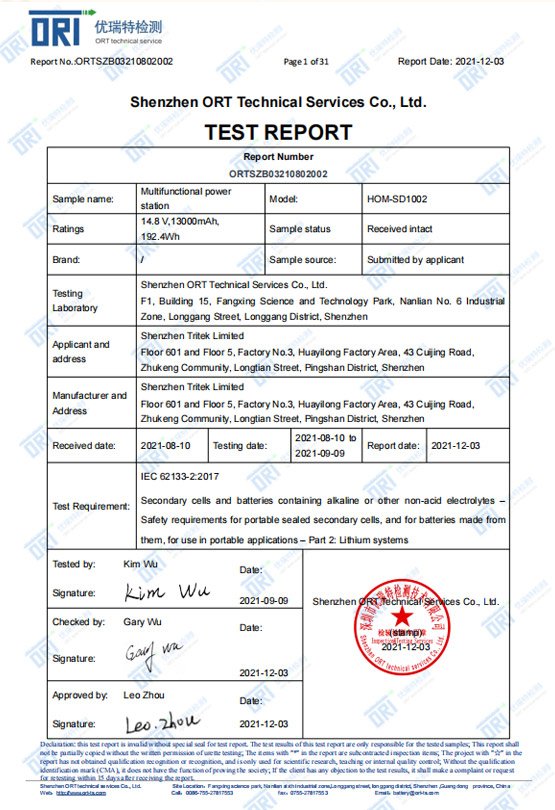
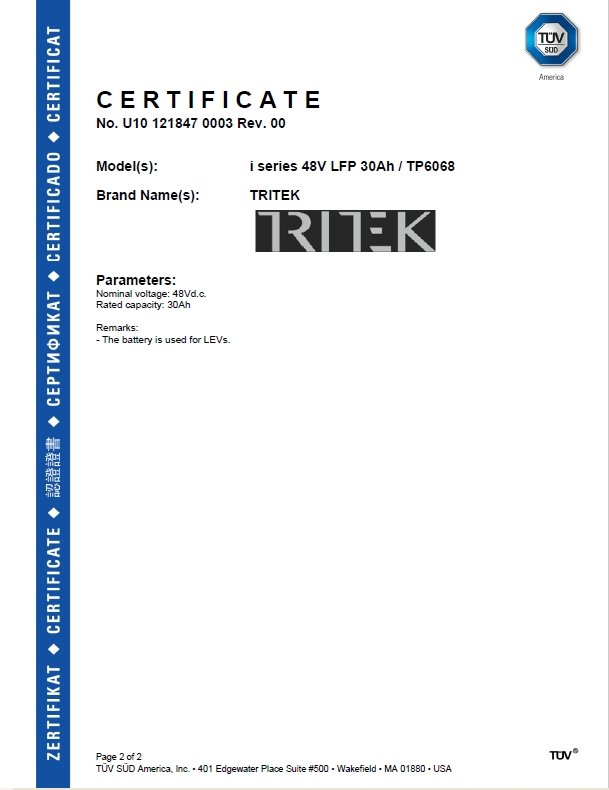
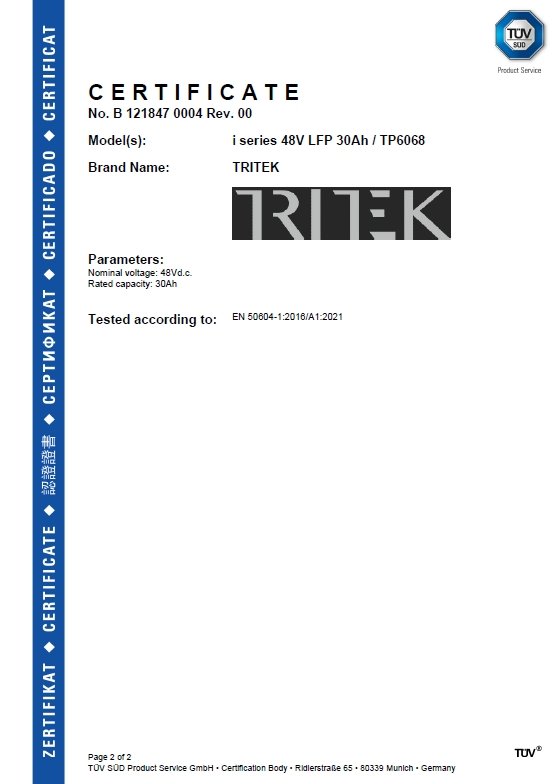
Depending on application and market, additional certifications may include:
For e-bike and LEV batteries, EN50604-1 is becoming increasingly important in Europe.
Prototype batteries may qualify for limited exemptions under strict approval procedures, but these shipments require special authorization.
State of Charge (SoC) Rules in 2026
State of Charge (SoC) restrictions are among the most important lithium battery air transport rules.
Why SoC Restrictions Exist
Lower charge levels reduce:
- Thermal runaway risk
- Heat generation
- Fire intensity
- Propagation risk
30% SoC Rule for UN3480
Lithium-ion batteries shipped standalone under UN3480 must remain at: SoC≤30
This long-standing rule remains strictly enforced in 2026.
New 2026 SoC Rules for UN3481
Beginning January 1, 2026:
- Lithium-ion batteries packed with equipment under PI966 may also require ≤30% SoC for batteries above 2.7Wh.
This represents a major compliance update.
Vehicle Battery SoC Restrictions
Electric vehicles powered by lithium-ion or sodium-ion batteries above 100Wh must also comply with:
- ≤30% rated capacity
or - ≤25% indicated capacity
unless approved otherwise.
Packaging Requirements
Packaging plays a critical role in lithium battery transportation safety.
Choosing the Correct Packing Instruction
Each battery type uses specific Packing Instructions (PIs), including:
- PI965: Lithium-ion batteries shipped standalone.
- PI966: Lithium-ion batteries packed with equipment.
- PI967: Lithium-ion batteries contained in equipment.
Each instruction defines:
- Quantity limits
- Packaging methods
- Label requirements
- Documentation obligations
Preventing Short Circuits
Battery terminals must be protected using:
- Insulating tape
- Plastic caps
- Individual inner packaging
- Non-conductive separators
Cushioning and Impact Protection
Packaging must prevent:
- Movement
- Crushing
- Vibration damage
- Mechanical impact
Foam inserts and structural reinforcement are commonly used.
Quantity and Weight Limits
Each Packing Instruction includes:
- Maximum package quantity
- Net weight limitations
- Aircraft restrictions
3m Stack Test Requirement
Section II packages must withstand stacking pressure equivalent to a 3-meter stack test.
This requirement received additional clarification in recent regulations.
Marking, Labeling, and Hazard Communication
Correct hazard communication is mandatory.
Lithium Battery Mark
Packages must display:
- Lithium battery handling marks
- Applicable UN numbers
Class 9 Hazard Label
Higher-quantity shipments require: Class 9 dangerous goods labels
Cargo Aircraft Only Label
Standalone lithium-ion batteries often require: Cargo Aircraft Only labels
Required Package Markings
Packages must include:
- Proper shipping name
- UN number
- Shipper information
- Consignee information
Air Waybill Statements
For Section II shipments, the Air Waybill may require statements such as: “Lithium ion batteries in compliance with Section II of PI967”
Common Labeling Errors
Frequent problems include:
- Incorrect UN numbers
- Missing labels
- Wrong label size
- Improper placement
Step-by-Step Process for Shipping Lithium Batteries by Air
Step 1 – Classify the Batteries
Determine:
- Chemistry type
- UN number
- Shipping configuration
- Watt-hour rating
Step 2 – Verify UN38.3 Compliance
Confirm:
- Valid test reports
- Available test summaries
- Certification records
Step 3 – Verify SoC
Ensure applicable batteries remain within allowed SoC limits.
Step 4 – Select Correct Packaging
Choose compliant:
- Packing Instructions
- UN-certified cartons
- Cushioning materials
Step 5 – Apply Marks and Labels
Verify:
- Correct UN number
- Proper hazard labels
- Cargo aircraft labels if required
Step 6 – Prepare Documentation
Prepare:
- DG Declaration
- AWB
- Test records
- Compliance documents
Step 7 – Book DG-Compliant Air Freight
Use experienced dangerous goods freight forwarders familiar with lithium battery logistics.
Step 8 – Final Inspection Before Shipment
Conduct final verification of:
- Packaging
- Labels
- SoC
- Documentation
before handing cargo to the airline.
FAQ about Ship Lithium Batteries by Air
Can lithium batteries be shipped on passenger aircraft?
Some small lithium batteries can be transported on passenger aircraft under strict limitations, but many standalone lithium-ion batteries are restricted to cargo aircraft only.
Is UN38.3 mandatory for air shipping?
Yes. Most lithium and sodium-ion batteries must pass UN38.3 testing before air transportation.
Why is the 30% SoC rule important?
Lower state of charge reduces thermal runaway and fire risk during transportation.
Can e-bike batteries be shipped by air?
Yes, but most e-bike batteries exceed 160Wh and therefore face stricter cargo aircraft and dangerous goods requirements.
What happens if a lithium battery shipment is non-compliant?
Non-compliant shipments may be rejected, delayed, fined, destroyed, or investigated by aviation authorities.
Are sodium-ion batteries regulated like lithium-ion batteries?
Increasingly yes. Sodium-ion batteries now have dedicated UN classifications and transport requirements.
References and Official Resources
- International Civil Aviation Organization (ICAO): Technical Instructions for the Safe Transport of Dangerous Goods by Air. Available at: https://www.icao.int/
- International Air Transport Association (IATA): Dangerous Goods Regulations (DGR) and Lithium Battery Guidance Document. Available at: https://www.iata.org/
- The United Nations Model Regulations: UN Model Regulations on the Transport of Dangerous Goods, Rev. 24. Available at: https://unece.org/transport/dangerous-goods/un-model-regulations-rev-24
- United Nations. UN Manual of Tests and Criteria, Part III, Subsection 38.3. Available at: https://unece.org/fileadmin/DAM/trans/danger/publi/manual/Manual%20Rev5%20Section%2038-3.pdf
National Aviation Authorities
- Federal Aviation Administration (FAA). Available at:: https://www.faa.gov/
- Pipeline and Hazardous Materials Safety Administration (PHMSA). Available at:https://www.phmsa.dot.gov/
- Civil Aviation Administration of China (CAAC). Available at: https://www.caac.gov.cn/English/
- European Union Aviation Safety Agency (EASA). Available at: https://www.easa.europa.eu/en