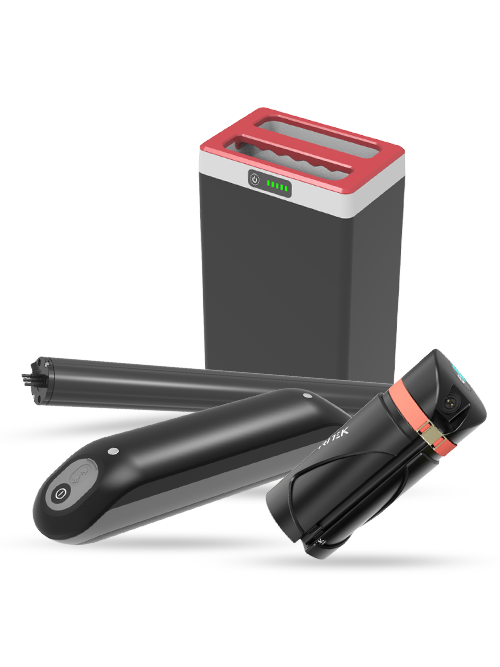
Lithium-ion batteries power modern technologies ranging from e-bikes and electric vehicles to robotics, energy storage systems, and industrial equipment. As battery energy density continues increasing, battery safety has become more important than ever. Among all battery safety issues, battery overcharge is one of the most critical because it can directly affect battery lifespan, performance, and even user safety.
Battery overcharge occurs when a battery continues receiving electrical current after reaching its maximum safe voltage limit. Overcharging can cause overheating, lithium plating, gas generation, swelling, accelerated degradation, and even thermal runaway. Modern lithium battery packs prevent overcharge through Battery Management Systems (BMS), voltage monitoring, temperature protection, and intelligent charging algorithms.
As lithium batteries become widely adopted in electric mobility and industrial applications, advanced overcharge protection technologies are now a fundamental requirement in battery pack design. This article explains what battery overcharge is, what causes it, the risks involved, and how intelligent battery systems prevent it.
What Is Battery Overcharge?
Battery overcharge occurs when a battery continues to receive current after reaching its maximum safe voltage or state of charge (typically 100%). This forces unwanted chemical reactions inside the cells.
How Normal Charging Works
Most modern rechargeable batteries, especially lithium-ion (Li-ion) and lithium-polymer (LiPo), follow a two-stage charging process:
- Constant Current (CC): Fast charging until the battery reaches ~70-80% capacity.
- Constant Voltage (CV): Charging slows as voltage stabilizes near the maximum (usually 4.2V per cell for Li-ion).
Once the battery hits full capacity, a properly designed system should stop or greatly reduce current flow (trickle charge). Overcharging bypasses this limit.
Battery Types Most Affected
Battery Type | Max Voltage (per cell) | Overcharge Sensitivity | Common Uses |
|---|---|---|---|
Lithium-ion / LiPo | 4.2V | Very High | Phones, EVs, laptops, e-bikes |
LiFePO4 | 3.65V | High | Solar storage, cargo bikes |
NiMH | 1.4-1.5V | Medium | Older devices, power tools |
Lead-acid | 2.4V (absorption) | Medium | Cars, UPS systems |
Key difference: Normal charging stops at safe limits. Overcharging pushes voltage higher, causing electrolyte decomposition, gas buildup, and heat.
What Causes Battery Overcharge?
Battery overcharge can result from several electrical, mechanical, or system-level failures.
Faulty Battery Charger
One of the most common causes is using an incorrect or low-quality charger.
If the charger outputs excessive voltage or fails to stop charging at the correct point, the battery may continue receiving current after becoming fully charged.
Common issues include:
- Incorrect charging voltage
- Unstable current output
- Poor-quality charging circuitry
- Lack of communication with the battery pack
Using uncertified chargers significantly increases overcharge risk.
Explore Tritek CE, UL & FCC Certified Chargers for 42–84V NCM and LFP Batteries
| Product model | TC1001 | TC1012-02 / TC1012-21 | TC1033 | TC1018-03 | TC1028 | TC1032 | TC1030-2 | TC1031 |
|---|---|---|---|---|---|---|---|---|
| Photo | 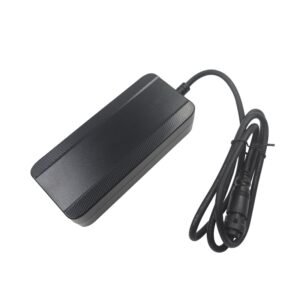 TC1001 product details TC1001 product details |  TC1012 product details TC1012 product details |  TC1033 product details TC1033 product details | 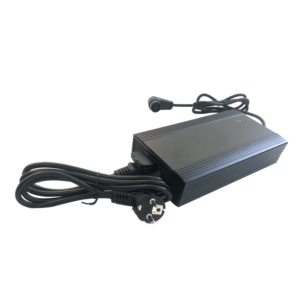 TC1018-03 product details TC1018-03 product details | 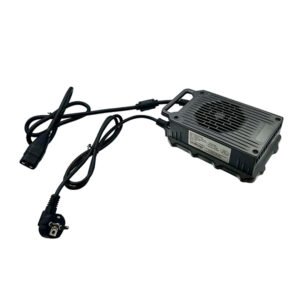 TC1028 product details TC1028 product details | 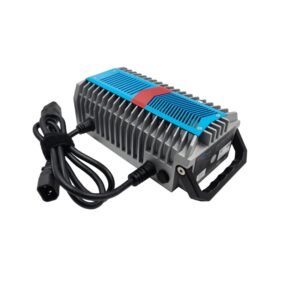 TC1032 product details TC1032 product details | 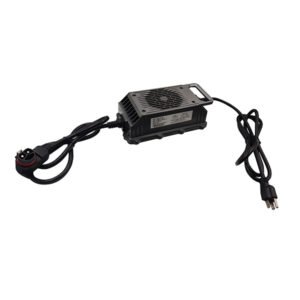 TC1030-2 product details TC1030-2 product details |  TC1031 product details TC1031 product details |
| Charge current | 3.0±0.3A | 3.0±0.3A / 4.0±0.3A | 4.5A/5A | 9A | 15A | 20A | 15A | 25A |
| Fit for battery of | 10-14S li-ion battery | 10S, 13S NCM 13S, 15S LFP | 10S, 13S NCM 13S, 15S LFP | 14S NCM 16S LFP | 12-14S NCM 14-16S LFP | 14S NCM 16S LFP | 17-20S NCM 23-24S LFP | 12-14S NCM 14-16S LFP |
| Output voltage | 42-58.8±0.2V | 54.6±0.2V / 42±0.2V | 54.6±0.2V / 42±0.2V | 58.8V | 48-58.6V | 40-58.8V | 72-84V | 48-58.6V |
| Dimension | 192*85.7*43mm | 159.4*81.1*33.9mm | 189*91*39.2mm | 220*120*49mm | 195*142*62mm | 252×141.8×86.4mm | 281*124*81mm | 252.5*160*82.5mm |
| Rated output power | 176.4W | 163.8W / 168W | 246W | 529.2W | 840W | 1200W | 1200W | 1200W |
| Material housing | Plastic | Plastic | Plastic | Aluminum | Aluminum | Aluminum | Aluminum | Aluminum |
| Cooling mode | Natural heat dissipation | Natural heat dissipation | Natural heat dissipation | Glued inside with fan | Full closed with fan outside,Glued inside | Fan outside,Glued inside | Full closed with fan outside,Glued inside | Full closed with fan outside,Glued inside |
| IP rating | IP20 | IP20 | IP20 | IP54 | IP67 | IP66 | IP65 | IP65 |
| Certification | CE:EN60335-1, EN60335-2-29, CE:EN55014-1/2, EN610003-3/2, FCC:FCC Part15B | CB,CE,FCC | CB, CE, FCC | UL, CB, CE | CE、FCC | UL, CB, CE | UL, CB, CE |
Battery Management System (BMS) Failure
The Battery Management System is responsible for monitoring and protecting lithium battery packs.
If the BMS fails, overcharge protection may stop functioning correctly.
Possible BMS failures include:
- MOSFET damage
- Voltage sensing inaccuracies
- Software logic failure
- Communication interruption
- Connector or wiring issues
A damaged BMS may fail to disconnect charging when cell voltage exceeds safe limits.
Improper Charger Compatibility
Different lithium battery chemistries require different charging profiles.
For example, using an NCM charger on a LiFePO4 battery pack can cause overvoltage conditions because their charging cut-off voltages are different.
Battery packs should always use compatible chargers designed for the correct chemistry and voltage range.
Cell Imbalance in Battery Packs
In multi-cell battery packs, individual cells may age differently over time.
Some weaker cells can reach full voltage earlier than others. Without proper balancing, these cells may become overcharged while the remaining cells continue charging.
Cell imbalance becomes more severe in large battery systems with high cycle counts.
High Temperature Environment
Charging batteries in extremely hot environments increases internal chemical activity and accelerates side reactions.
Poor thermal management can worsen overcharge effects and increase the probability of thermal runaway.
What Happens When a Battery Overcharges?
Battery overcharge can trigger multiple dangerous reactions inside lithium-ion cells.
Excessive Heat Generation
Overcharging increases internal resistance and causes electrochemical instability.
As voltage rises above the safe limit, more energy converts into heat instead of stored chemical energy.
If the heat cannot dissipate effectively, cell temperature rises rapidly.
Lithium Plating
One of the most damaging effects of overcharge is lithium plating.
During overcharging, metallic lithium deposits on the anode surface instead of intercalating normally into the graphite structure.
Lithium plating can:
- Permanently reduce battery capacity
- Increase internal resistance
- Create internal short circuits
- Reduce cycle lifespan
This damage is usually irreversible.
Gas Generation and Cell Swelling
Overcharge can decompose the electrolyte inside the battery.
This decomposition produces gases that accumulate inside the sealed cell, causing swelling or deformation.
Swollen batteries are a major warning sign and should never continue being used.
Accelerated Battery Degradation
Even minor overcharge events accelerate battery aging.
The battery may experience:
- Faster capacity fade
- Reduced cycle life
- Higher self-discharge rate
- Reduced power output
Repeated overcharge exposure can dramatically shorten battery lifespan.
Thermal Runaway and Fire Risk
Severe overcharge may eventually trigger thermal runaway.
Thermal runaway is a self-accelerating reaction where rising temperature causes more internal reactions, generating even more heat.
This chain reaction can lead to:
- Smoke generation
- Fire
- Explosion
- Toxic gas release
Thermal runaway is one of the primary safety concerns in lithium-ion battery systems.
How Battery Protection Technologies Work
Modern devices incorporate multiple safety layers:
Battery Management System (BMS) The BMS continuously monitors voltage, current, and temperature for each cell. When it detects an overvoltage condition (e.g., approaching or exceeding 4.2V), it cuts off the charging circuit.
Overcharge Protection Circuits Dedicated chips halt charging at the precise voltage threshold and often include redundant fuses or MOSFET switches.
Temperature Sensors If the battery gets too hot, charging slows or stops entirely.
Smart Charging Protocols Features like Apple’s Optimized Battery Charging or Android’s Adaptive Charging learn your habits and hold the battery at 80% until needed, reducing time spent at full charge.
Signs of Battery Overcharge
Recognizing early overcharge symptoms can help prevent severe battery failure.
Excessive Heat During Charging
If a battery becomes unusually hot while charging, it may indicate overcharge or charging system failure.
Battery Swelling
Swelling or deformation is a serious warning sign caused by internal gas generation.
Swollen batteries should immediately stop being used.
Strange Odor or Leakage
Electrolyte decomposition may produce unusual smells or leakage.
This condition can become dangerous if ignored.
Rapid Capacity Loss
An overcharged battery often experiences sudden reduction in runtime and overall capacity.
Abnormal Charging Behavior
Possible symptoms include:
- Charging too quickly
- Charging too slowly
- Failure to stop charging
- Unstable battery percentage display
These issues may indicate charger or BMS malfunction.
Battery Overcharge vs Overdischarge
Although both conditions are harmful, overcharge and overdischarge affect batteries differently.
Item | Overcharge | Overdischarge |
|---|---|---|
Voltage Condition | Voltage too high | Voltage too low |
Main Risk | Overheating and fire | Capacity degradation |
Damage Type | Thermal and chemical damage | Chemical instability |
Safety Risk | Very high | Moderate |
Protection Method | Charge cut-off | Low-voltage cut-off |
Conclusion
Battery overcharge is one of the most critical safety challenges in lithium-ion battery systems. Overcharging can lead to overheating, swelling, lithium plating, accelerated degradation, and thermal runaway.
As electric mobility and industrial electrification continue expanding, advanced overcharge protection will remain essential for ensuring battery reliability, lifespan, and user safety.
For OEMs, fleet operators, and equipment manufacturers, choosing battery suppliers with strong BMS development capability, international certifications, and intelligent battery technologies is increasingly important for building safer and longer-lasting lithium battery systems.
FAQs About Battery Overcharge
Can overcharging destroy a lithium battery?
Yes. Severe overcharging can permanently damage lithium-ion batteries and may even cause thermal runaway or fire.
Can a BMS completely prevent overcharge?
A high-quality BMS greatly reduces overcharge risk, but overall safety also depends on charger quality, thermal design, wiring integrity, and system maintenance.
Is overnight charging safe?
Modern intelligent battery systems are generally designed to stop charging automatically after reaching full charge. However, using certified chargers and batteries is still essential.
What voltage is considered overcharge?
It depends on battery chemistry. For many NCM lithium-ion cells, voltage above 4.2V per cell is considered overcharge.
Can overcharged batteries be repaired?
Minor overcharge may only reduce lifespan, but severely overcharged batteries are often unsafe and should be replaced.
Does fast charging increase overcharge risk?
Fast charging itself does not necessarily cause overcharge if managed correctly. However, it increases thermal stress and requires more advanced charging control and thermal management.